Useful Mongolian phrases for travellers
Twenty words and phrases of Mongolian that make a difference on a trip, with simple pronunciation and notes on names and the alphabet.
3 min read · Updated
Mongolian is spoken by nearly everyone in Mongolia. It is unrelated to Chinese or Russian, and it sounds like neither. In Ulaanbaatar many younger people speak some English. In the countryside very few do, which is one reason nearly all visitors travel with a guide.
Nobody expects you to speak Mongolian. But greeting a family in their own language, however badly, is always noticed and always appreciated.
The essentials
| English | Mongolian | Say it like |
|---|---|---|
| Hello | Sain baina uu | sain bain oo |
| Hello (reply) | Sain, sain baina uu | sain, sain bain oo |
| Thank you | Bayarlalaa | ba-yar-la-LAA |
| Goodbye | Bayartai | ba-yar-TAI |
| Yes | Tiim | teem |
| No | Ugui | oo-GWEE |
| Sorry, excuse me | Uuchlaarai | OH-chla-rai |
| It's fine, no problem | Zugeer | ZU-geer |
| Good, nice | Sain | sain |
| Delicious | Amttai | AMT-tai |
| Beautiful | Saikhan | SAI-khan |
| How much is it? | Ene khed ve? | en khed vey |
| What is your name? | Tany ner khen be? | tany ner khen bey |
| My name is ... | Minii ner ... | minee ner |
| I don't understand | Bi oilgokhgui baina | bee OIL-gokh-gwee bain |
| Water | Us | oos |
| Tea | Tsai | tsai |
| Toilet | Jorlon | JOR-lon |
| Let's go | Yavya | YAV-ya |
| Cheers | Tugtuuye | tog-TOY |
The sound written kh is a rough "h" from the back of the throat, like the "ch" in Scottish "loch".
Greetings in the countryside
Greetings among herders are a short exchange of questions about the things that matter:
- "Sain baina uu?" (Are you well?) "Sain." (Well.)
- "Mal süreg targan uu?" (Are your animals fat?)
- "Zun sain bolj baina uu?" (Is the summer going well?)
The answer is always positive. Problems are mentioned later, if at all.
When approaching a ger, the traditional call is "Nokhoi khor!", "Hold the dog!". See ger etiquette.
Words you will hear every day
- Ger: the round felt tent. "Yurt" is a Russian word that Mongolians do not use.
- Deel: the long traditional robe worn by men and women, tied with a sash.
- Aimag, sum: province and district. Mongolia has 21 aimags.
- Nuur, gol, uul: lake, river, mountain. Khuvsgul Nuur is Khuvsgul Lake.
- Els: sand. Khongoryn Els is the Khongor sand dunes.
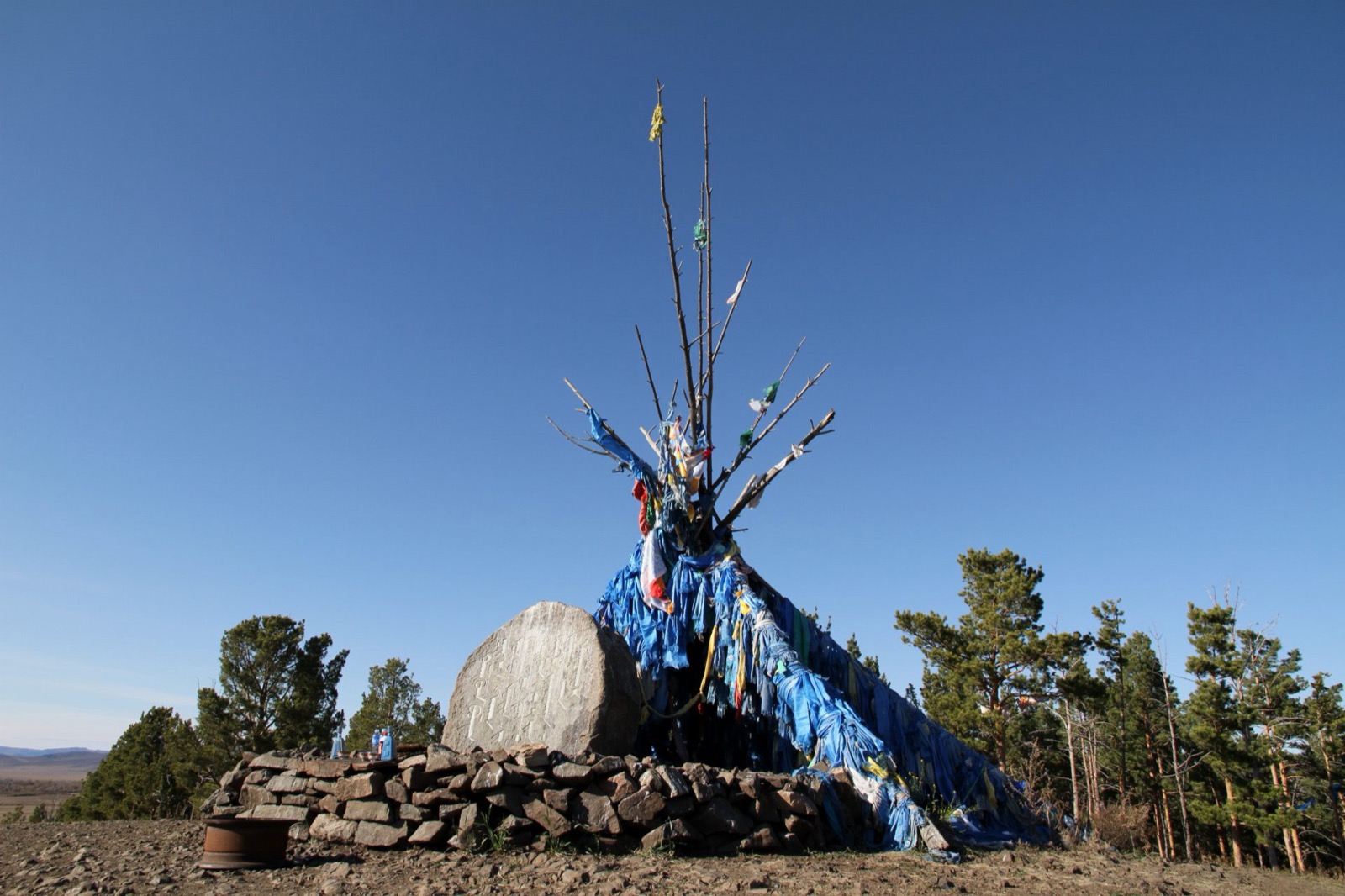
- Ovoo: a cairn of stones on a pass or hilltop, sacred to the local spirits. Travellers walk around it three times clockwise and add a stone.
- Airag, suutei tsai, buuz, khuushuur: see Mongolian food and drink.
- Naadam: festival, literally "games".
- Takhi: the wild horse, known abroad as Przewalski's horse.
The alphabet
Mongolian has been written in the Cyrillic alphabet since the 1940s, with two extra letters, Ө and Ү. Street signs, menus and maps are in Cyrillic, so learning the 35 letters, which takes an evening, is useful in town.
The older traditional Mongolian script is written vertically, from top to bottom, in columns running left to right. It dates from the time of Chinggis Khaan, is taught in schools, and is returning to official use alongside Cyrillic. You will see it on banknotes, monuments and government buildings.
Because there is no single agreed way of writing Mongolian in Latin letters, place names are spelled many ways. Khuvsgul, Hovsgol and Khövsgöl are the same lake. Ulaanbaatar and Ulan Bator are the same city.
Names
Mongolians use a single given name. In front of it they place their father's (or sometimes mother's) name in the possessive form, often shortened to an initial. So "B. Bold" is Bold, the son of Bat. People are addressed by their given name, and to someone older you add a respectful "guai": "Bold guai".
Many names have beautiful meanings: Naran (sun), Tsetseg (flower), Bat (firm), Munkh (eternal), Altan (golden), Erdene (jewel).